
Young hands,
new life for
Mid-Autumn traditions
By preserving traditional techniques while experimenting with materials, forms and designs, a new generation of Vietnamese artists and craft makers is finding fresh ways to keep the heritage of Mid-Autumn toys alive.
Story by Lê Hương
Photo by Bảo Long & Lê Hương
By preserving traditional techniques while experimenting with materials, forms and designs, a new generation of young artists and craft makers is finding fresh ways to keep the heritage of Mid-Autumn toys alive.
As the festival approaches, the old streets of Hà Nội are taking on a familiar glow, with animal-shaped lanterns, paper figures and traditional toys appearing in exhibition spaces across the Old Quarter.
Yet behind these familiar images is something less nostalgic and more contemporary: a growing effort by young Vietnamese creators to bring old handicrafts back into everyday life by combining traditional techniques with new ideas.
At the Lưu Trăng exhibition at the Cultural and Arts Centre at 22 Hàng Buồm Street, young creative brands including Thong Dong, Của Nả and The Annam have worked with artisans and cultural researchers to study, restore and reinterpret traditional Mid-Autumn toys.
Their work draws on old photographs, historical documents, traditional techniques and folk aesthetics, while adapting designs and materials for contemporary audiences.
For visitors, the result is both familiar and unexpected.
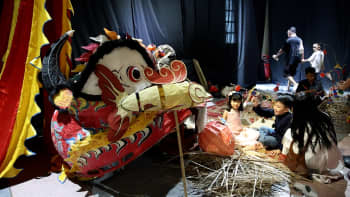
Large lanterns shaped like animals, colourful paper figures and models of toys once given to children fill the exhibition spaces.
Visitors can also attend talks about the history and cultural significance of Mid-Autumn traditions and try making toys themselves under the guidance of artisans and experts.

The Lưu Trăng exhibition attracts both domestic and international visitors. VNS Photo Lê Hương
The Lưu Trăng exhibition attracts both domestic and international visitors. VNS Photo Lê Hương
From old photographs to new designs

'Tiến sĩ giấy’, or paper scholar, by The Annam group. VNS Photo Lê Hương
'Tiến sĩ giấy’, or paper scholar, by The Annam group. VNS Photo Lê Hương
For Nguyễn Đức Anh of The Annam, reviving traditional toys begins with understanding why they existed in the first place.
Among his creations is an enlarged version of the traditional ‘tiến sĩ giấy’, or paper scholar, a figure once given to children as a wish for academic success.
“Traditionally, our ancestors gave children paper scholars, or ‘paper doctor’ figures, as toys, as a way of wishing them success in their studies, because Vietnamese people have always placed a high value on education,” he said.
The original figures were small enough to fit on a Mid-Autumn offering tray. Anh has enlarged his version for the exhibition while retaining its handmade character, using paper over a bamboo framework.
“We hope young people will reconnect with cultural heritage, including old traditional objects that are almost forgotten, and bring them back into everyday life,” he added.
That approach is also evident in the lanterns created by architect Trịnh Văn Khuê of Của Nả.
His team developed lanterns in the shapes of fish, shrimp, crabs and butterflies, along with ceremonial lanterns and fruit-shaped designs such as pomegranate and peach.
Animal-shaped lanterns at the Lưu Trăng exhibition. VNS Photo Lê Hương
Animal-shaped lanterns at the Lưu Trăng exhibition. VNS Photo Lê Hương
The process started not with modern design software but with research.
The team studied photographs taken by French researchers and illustrations in 'Technique of the Annamese People', looking for evidence of lantern designs that had once existed in Việt Nam.
They then had to work out how to reproduce them.
Traditional bamboo had to be soaked and prepared before being bent into shape, while large lanterns required several layers of paper to achieve both strength and translucency.
At the same time, the makers introduced contemporary elements, including slight changes to the shapes and the use of milk glue in the paper-making process.
For Khuê, the objective is not simply to reproduce old objects. It is also to remind people that Việt Nam once had a sophisticated tradition of handicraft production.
“We want to bring back some products that have once appeared in Việt Nam to show how sophisticated the country’s traditional handicrafts and fine craftsmanship were,” he said.
A butterfly-shaped lantern at the exhibition. VNS Photo Bảo Long
A butterfly-shaped lantern at the exhibition. VNS Photo Bảo Long
Yet even deep familiarity cannot guarantee success across a 1,000-hectare site. Some days, they hike for kilometres under the sun, finding only broken fossils. Other days, promising trails disappear into rubble.
Still, they return whenever they can. In palaeontology, the work consists mostly of patient searching. Actual discoveries are rare.
By the fifth day, exhaustion was etched on their faces. As usual, they separated at the edge of a freshly exposed seam. They moved methodically, crouching for long stretches to examine shale layers before moving on.
Near noon, amid the vast silence broken only by distant excavators, Vĩnh's voice rang out.
Tradition meets technology
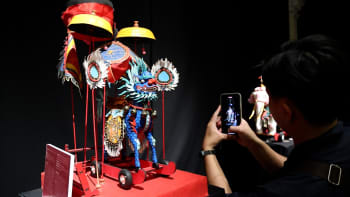
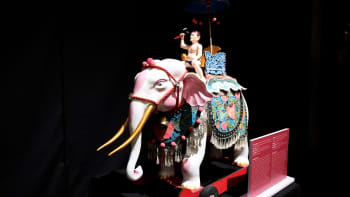
Another example comes from Nguyễn Văn Bắc of Thong Dong, who has revived models of old children's toys, including elephants, horses, dragon-horses and miniature lion heads.
His interest developed through field research into Vietnamese folk paintings and historical images of children playing with traditional toys.
After years of collecting and studying the material, he felt 2026 was the right time to recreate some of them.
But faithful restoration does not necessarily mean using exactly the same materials.
Many of the original toys were made from papier-mâché or tin.
Bắc said these materials would not necessarily provide the safety and durability expected today, so he uses plastic and wood for some recreated toys.
Bắc learned the decorative motifs for his toys from the pagodas and temples he visited.
Bắc learned the decorative motifs for his toys from the pagodas and temples he visited.
Technology also has a role.
After studying the forms of Vietnamese animal figures at monuments and heritage sites, he combined the findings into new designs and created 3D files from which models could be produced while retaining traditional characteristics.
At the same time, he keeps handmade elements in the toys, such as fabric armour for horses and elephants, with stitching and other traditional craft techniques.
For the miniature lion heads, he retains papier-mâché but adds layers of paint to improve durability.
The result reflects a broader understanding of heritage: tradition does not necessarily have to remain frozen in its original form.
Keeping the craft in living hands
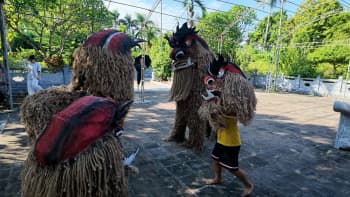
The same spirit can be seen more than 100km away, in Búng Village, Vạn Xuân Commune, Hưng Yên Province, where the generations-old craft of making lion, or kylin, dance heads continues to be practised.
Only a few families in the village still preserve the craft, which is believed to date back to 1959.
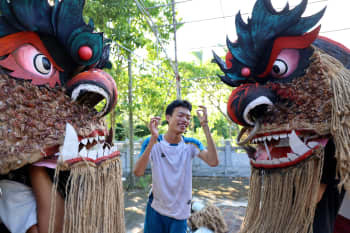
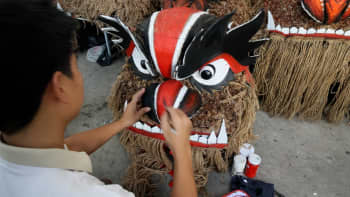
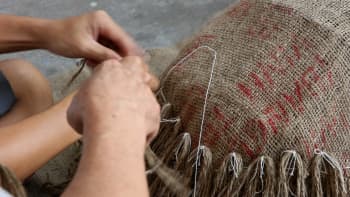
Traditional materials such as bamboo and jute fibre remain central to the handmade heads, while each maker may develop distinctive facial designs.
Phạm Như Lợi (centre), his wife and son make lion heads for children in Búng Village, Hưng Yên District. VNS Photo Lê Hương
Phạm Như Lợi (centre), his wife and son make lion heads for children in Búng Village, Hưng Yên District. VNS Photo Lê Hương
For 83-year-old Phạm Như Lợi, the kylin is one of Việt Nam’s four sacred animals and is closely associated with folk culture.
His son, 30-year-old-something Phạm Như Kiên, has been making dance heads for nearly two decades.
Kiên preserves the original mould but has introduced small changes, particularly to the eyes, giving the traditional figure a stronger and more distinctive personality while retaining its original character.
A freehand painter by profession, he has also brought his own artistic interests into the craft.
“I hope to share this unique cultural beauty from my hometown with people everywhere,” he said.
The craft therefore survives not simply because an old form is copied, but because younger makers continue to find reasons to work with it.
That connection extends to the performers themselves.
Fifteen-year-old Đỗ Hoàng Hiệp, who takes part in the kylin dance, said the most difficult part is coordinating the movements of the two performers.
Eleven-year-old Nguyễn Anh Khoa plays the cymbals and prefers the lively activity to video games because it allows him to spend time with friends.
For Trần Hậu Yên Thế of Hà Nội National University, the village's kylin heads are compelling precisely because they retain their Vietnamese character.
“The hornless lion design, handmade materials and use of hemp fibre reflect traditional Vietnamese art and rural culture,” he said.
A tradition for a new generation
The young creators behind the Old Quarter exhibitions appear to understand that preserving heritage requires more than protecting old objects.
Stella Ciorra, Chairperson of Friends of Vietnam Heritage, was struck by the participation of young Vietnamese artists, many of them around 19 to 21 years old or recently graduated from fine arts and industrial fine arts universities.
She sees their involvement, alongside older scholars and artisans, as important to the future of the traditions.
The audience is young, too.
Visitor Lê Ngọc Thùy Linh said she was surprised by the beauty of the displays, which reminded her of stories told by her parents.
What impressed her most was seeing young people use modern forms to connect with and pass on Vietnamese culture to their peers.
For Ciorra, this is perhaps the most significant change: young Vietnamese artists are not merely inheriting traditions, but taking them in new directions.
In the process, Mid-Autumn toys become more than seasonal decorations.
Paper, bamboo, wood, fabric and paint are combined with research, design and even 3D technology.
Old images become new forms, while forgotten toys are given another chance to enter contemporary homes and children's lives.
The challenge is to ensure that innovation does not erase the character of the originals. But in capital Hà Nội and Búng Village, the work of a new generation suggests that heritage can remain recognisable while continuing to evolve.
As the Mid-Autumn Festival arrives, the brightest lanterns may therefore be those that illuminate not only the past, but also a possible future for Việt Nam's traditional handicrafts. VNS
 Built with Shorthand